


If you’ve ever struggled to keep up with your journal, you are definitely not alone. This whole post is dedicated to tips and tricks to make it easy (and fun) to keep up with your journal on a regular basis. The goal, of course, is not to force yourself to journal if you’re not enjoying it, but rather to find the best way to turn your journaling hobby into a habit.
This page contains affiliate links – this means that I earn a small commission if you shop through them. However, I will only ever recommend products I have used myself and truly love. As always, I appreciate your support!
- Define your journal’s purpose.
- Keep it accessible.
- Make it a part of your routine.
- Make it simple.
- Make it fun.
- Keep it flexible.
- Avoid perfectionism
Define your journal’s purpose.
Of everything written in this post, this is the most important. Purpose will not only determine how you use your journal, but it is also what will motivate you to keep using it. Is what’s going inside the journal important to you? How will you format the content of your journal? Will you be motivated to keep up with it in the long term? Will you want to keep it after it’s done? Defining the goal of your journal before you start is key to answering all these questions.
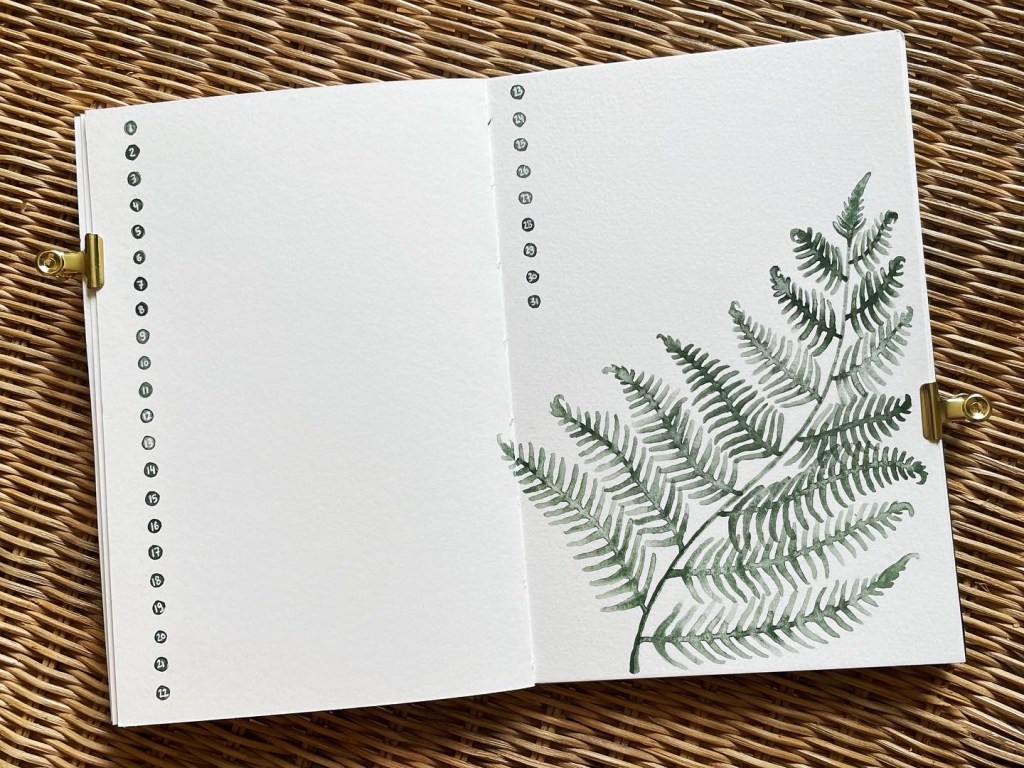
I started journaling in my sketchbook because I wanted somewhere to record my memories in a place I knew I would keep forever. Years later, my personal journal is still the place where I keep memories and practice art. Most importantly, the desire to keep doing those two things – not the desire to “journal” itself – are the reasons I keep doing it consistently.
While your journal’s purpose should be the main driver behind wanting to make journaling a habit, the rest of these tips are ways you can make it easier to adopt the habit.
Keep it accessible.
Keeping your journal visible and in the location where you will use it is the easiest thing you can do to remind yourself to use it. If you journal during breakfast, keep your journal near the kitchen table. If you journal before going to sleep, keep your journal on your bedside table. You get the gist.
Make it a part of your routine.
A fantastic reference for turning anything into a habit is Atomic Habits by James Clear. One piece of advice that I loved from this book is the idea of habit stacking: in short, linking a new habit to an already established habit makes adopting it easier. For example, deciding to journal during your morning coffee means you will never forget to journal since you know you can’t start the day without that coffee anyways.
Make it simple.
This tip is all about making it easy to keep up with your journal, and lowering the barriers to using it so that you nothing stands in the way of you picking it up. For me, this best way to do this is to simplify each step of using my journal:
Choose the basic tools your will need, and store them right alongside your journal. That way, when the time comes to use your journal, there’s no prep involved because you’ll have everything you need on hand. I recommend starting with the bare minimum: Most often, that means having a dedicated pen for your journal, either stored next to it or attached to it. A little extra tip: if your journal doesn’t have a place to attach your pen, you can buy an adhesive pen loop and stick it on the inner back cover.
If you want art or decorations in your journal, try starting simple there too: choose a single color marker or highlighter for your journal, or choose a theme for your journal and keep on-theme stickers and decorations in the back pocket. Then as the habit forms, you can expand! If you’re not sure what tools to use, check out my last post on my favorite stationery – it has my top recommendations for all the basic tools you could possibly need.
Make sure actually using your journal is simple too. Aim so that keeping up with your journal only takes you a couple of minutes, so you know you’ll always have time to spare for it. And if you end up deciding to spend more time with it once those few minutes are up, then great! To do this, you’ll have to adapt the content of your journal so that filling it out is easy. Here are some examples of how you can do that:
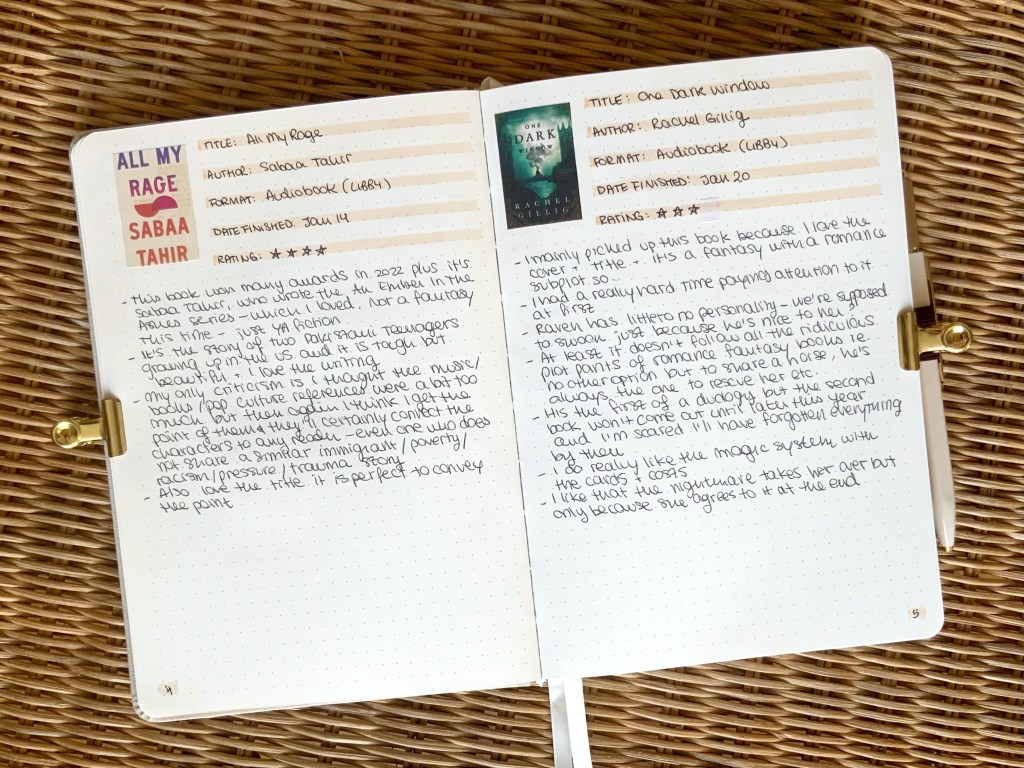
Example #1: I love seeing the aesthetic reading journals spreads other people make on instagram or pinterest, but I also know that making an aesthetic spread for every book I read (I read a lot) will take forever, so I will procrastinate until I’ve fallen months and months behind and it feels impossible to catch up. By then I’ll have forgotten all about the books I read anyways, which defeats the purpose.
Instead, I decided to make my reading journal spreads super simple so that I will actually fill them out consistently. All I have to do is write the book’s details on top of the page, write my thoughts with a simple black pen, then flip the page and continue on to the next book.
Example #2: For my personal journal, where the spreads are much more elaborate and decorated, I plan one long session to make and decorate the spreads at the start of the month (usually on a weekend). During that session, I will take time to decorate but I’ll also prepare everything I’ll need so that filling out my journal throughout the rest of the month only takes a few minutes. That way, even though my spreads are more complex, using them is easy.
Make it fun.
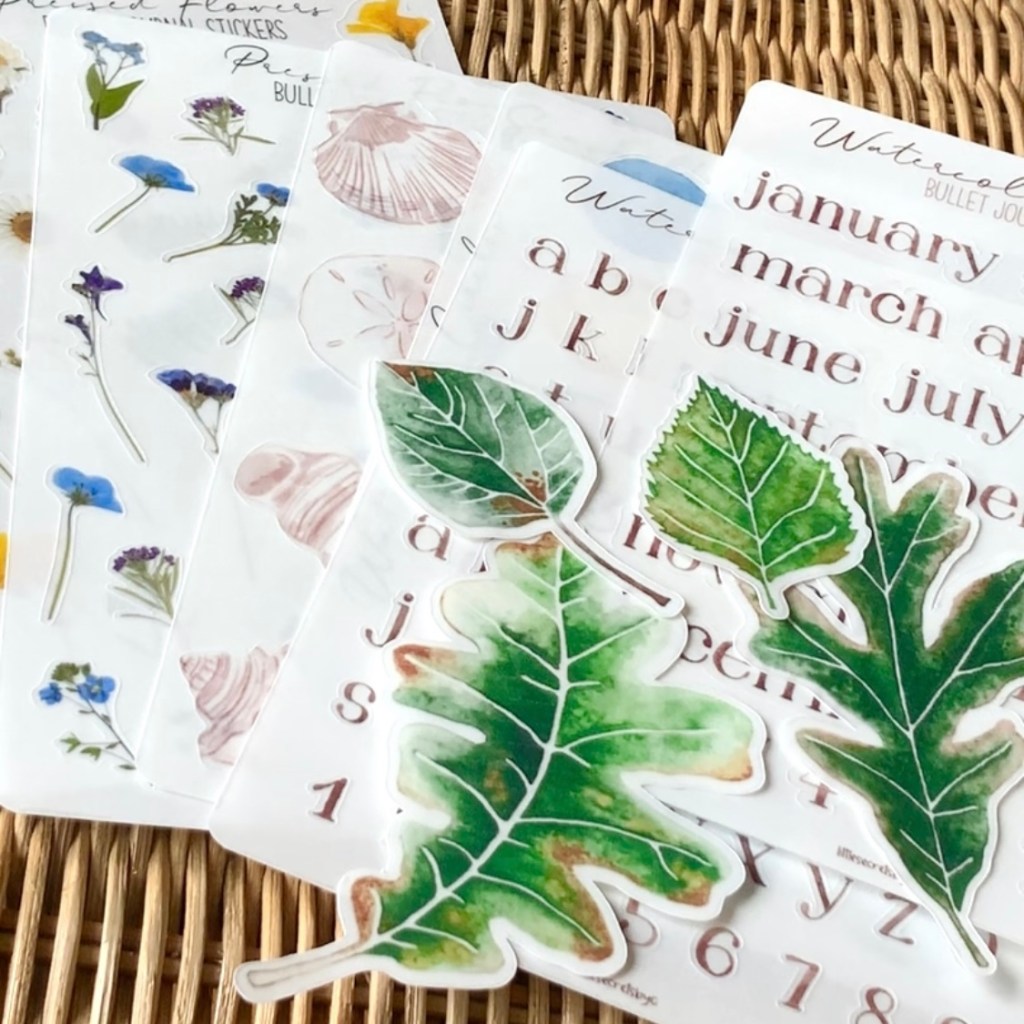
This is what will make keeping up with your journal gratifying, even addictive sometimes!
For a lot of people, making it fun means making it aesthetically pleasing – so making pretty layouts or adding art or stickers. For journals where I mostly write, I like to write with pretty ink (my favorites are from Atlas Stationers) or add pretty headers.
Making it fun can also mean making it gratifying in other ways: creating trackers to visualize your progress on a project, or writing checklists so that you can check off items once you’ve accomplished them. With trackers and checklists, your journal can serve as the motivation to keep up with other habits – like reading or exercise. Essentially, your journal becomes its own reward system, which makes you want to open it up and update it. I really like the way Ryder Carroll talks about this in his book The Bullet Journal Method, so if you’re interested, give it a read. Remember to start simple, though! Don’t immediately add a million trackers and checklists to your journal, or decide each spread should be an artistic masterpiece.
Another way you can make journaling fun is to share your spreads on social media. I’ve found the journaling community on instagram to be super supportive, and it’s always gratifying to get a few likes and feedback on a spread you’ve spent time on. There’s so many different accounts with different styles within the journaling community, from super minimalistic to super artistic, so you’re sure to find peers no matter your style. It’s also a great way to get inspiration and tips from the people you follow, which can motivate you too! Obviously, this can be a bit of a slippery slope, so make sure you remember your purpose and don’t let posting become the focus of your journal!
Keep it flexible.
As your life changes, you won’t always need the same things out of your journal or have the same amount of time to invest in it. Rather than break the habit altogether, let your journal evolve with you.
- If you find you’re not keeping up with your journal, think of how you can simplify it. It’s totally find to change styles midway through a journal, especially if it means you will actually be able to fulfill your journal’s purpose.
- Test out new tools. I find that using a new pen or a new set of stickers can be motivation enough open up my journal. Along those lines, you can reignite your excitement by choosing a new theme within your journal. I like to change my theme (decorations, header styles, color scheme, etc) each month, which keeps me excited to make my spreads each time.
- Test different spreads or layouts. The best way to figure out what works for you is to test different options. There’s tons of different ways to do a weekly spread or a memory spread, so try a different format each month until you find what works for you. And if it stops working for you, try something else.

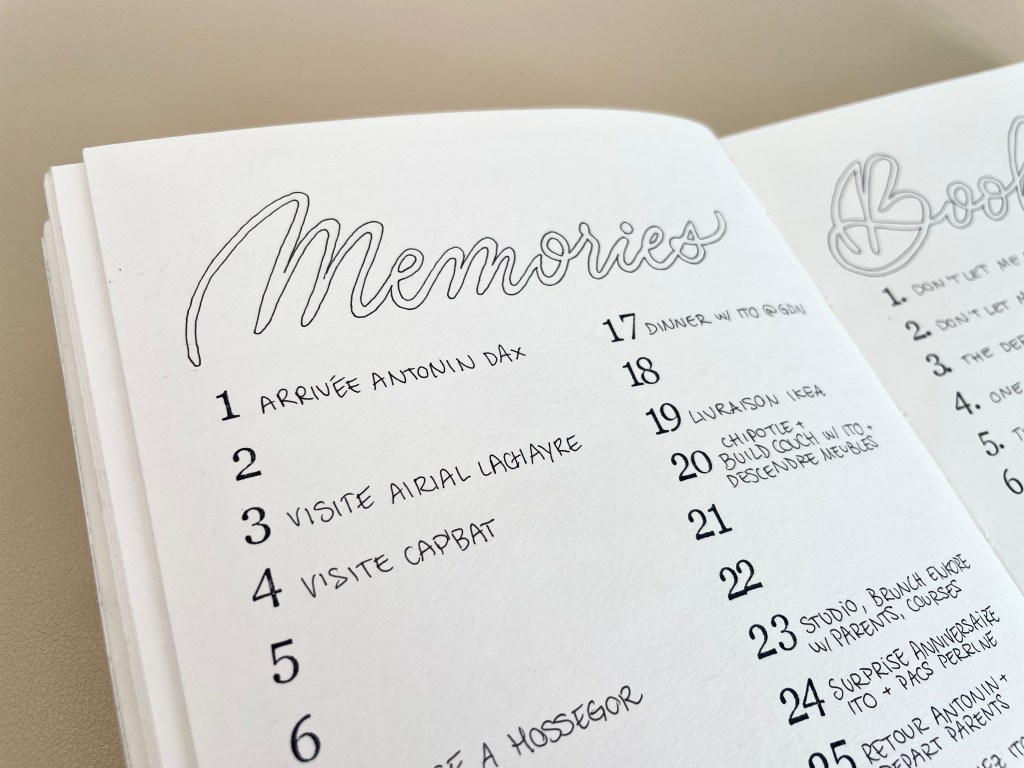
- Adjust the content. Some days you’ll want to devote hours to journaling, others you’ll barely have the energy to open it up. Rather than letting it become stressful or difficult, adapt the content to whatever you can accomplish that day. I spend quite a bit of time decorating my journal each month, but on months where I get too busy, I’ll make the theme super minimalistic so that I will still be sure to record my memories.
- Keep only what you like. You also don’t have to keep a spread if you find that you’re not using it. Removing trackers or spreads you never fill out will not only save you time, but it’ll also get rid of that guilt you feel every time you see it, which in turn will make opening your journal that much more enjoyable. And it’s supposed to be enjoyable!
Avoid perfectionism
You’ve probably heard this before and, yes, it’s easier said than done. I’ve see (and felt) perfectionism get in the way of my journaling in two major ways:
- I don’t think I need to explain blank page syndrome to anyone. There’s really no other way to get past it than making that first mark. Or even, making a fist mistake. Sketching out a spread in pencil before you make that first mark in pen can help too!
- Skipping a day is fine. Skipping a month is fine. But don’t let a gap that stop you from going back to your journal. You can fill things out retroactively, and you can also accept the gap and move forward!
There really are no rules as to how you fill out your notebook, so long as it suits your purpose. Everything written here are just recommendations from my own experience, but your journal doesn’t need to be like anyone else’s. It doesn’t need to look a certain way, and it doesn’t need to contain what you see in other people’s journals. No one else even has to know, so long as it serves you!

 Petites Pensées Papeterie